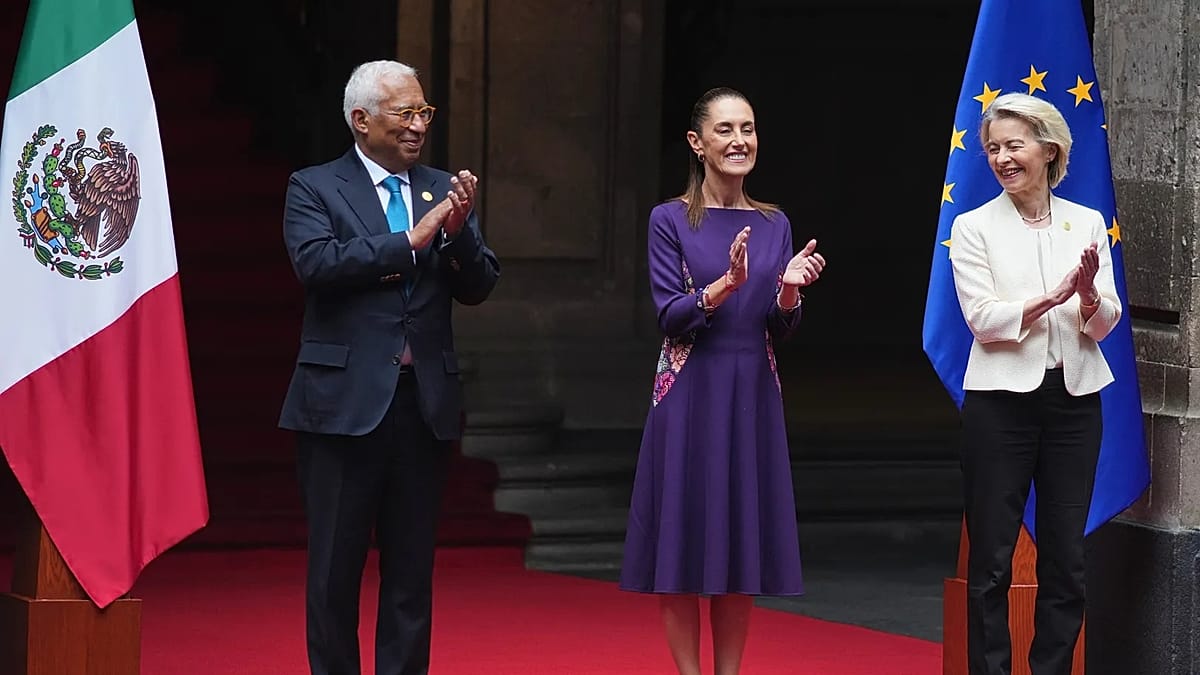
EU Mexico Trade Deal - profitability outlook, cost efficiency, and margin trends. European Union leaders signed an updated trade agreement with Mexico on Friday, replacing the original deal from two decades ago. The pact aims to strengthen economic ties and reduce both parties' dependence on the United States and China amid rising geopolitical tensions.
Live News
EU Mexico Trade Deal - profitability outlook, cost efficiency, and margin trends. Many investors adopt a risk-adjusted approach to trading, weighing potential returns against the likelihood of loss. Understanding volatility, beta, and historical performance helps them optimize strategies while maintaining portfolio stability under different market conditions. On Friday, EU Commission President Ursula von der Leyen and European Council President António Costa signed an updated trade deal with Mexico, marking the first major revision of the agreement since its original signing two decades ago. The new pact is designed to deepen economic cooperation between the EU and Mexico, one of Latin America's largest economies. According to the European Commission, the updated agreement will eliminate tariffs on nearly all goods traded between the EU and Mexico, including agricultural products, industrial goods, and services. It also includes provisions on intellectual property, sustainable development, and digital trade. The deal is seen as a strategic move by both sides to diversify their trade partners and reduce exposure to the U.S. and Chinese markets, which have become increasingly contested amid trade disputes and geopolitical uncertainty. The signing ceremony took place in Brussels, with von der Leyen calling the agreement a "milestone" for EU-Latin American relations. The deal must still be ratified by the European Parliament and all EU member states, as well as by Mexico's Senate, before it can take full effect. However, provisional application of certain trade provisions could begin earlier.
EU and Mexico Sign Updated Trade Deal to Reduce Reliance on US and China Many traders use alerts to monitor key levels without constantly watching the screen. This allows them to maintain awareness while managing their time more efficiently.The interplay between macroeconomic factors and market trends is a critical consideration. Changes in interest rates, inflation expectations, and fiscal policy can influence investor sentiment and create ripple effects across sectors. Staying informed about broader economic conditions supports more strategic planning.EU and Mexico Sign Updated Trade Deal to Reduce Reliance on US and China While algorithms and AI tools are increasingly prevalent, human oversight remains essential. Automated models may fail to capture subtle nuances in sentiment, policy shifts, or unexpected events. Integrating data-driven insights with experienced judgment produces more reliable outcomes.Maintaining detailed trade records is a hallmark of disciplined investing. Reviewing historical performance enables professionals to identify successful strategies, understand market responses, and refine models for future trades. Continuous learning ensures adaptive and informed decision-making.
Key Highlights
EU Mexico Trade Deal - profitability outlook, cost efficiency, and margin trends. Real-time data can highlight sudden shifts in market sentiment. Identifying these changes early can be beneficial for short-term strategies. Key takeaways from the deal include a potential boost for EU exports of machinery, pharmaceuticals, and vehicles to Mexico, while Mexican agricultural products such as avocados, tequila, and berries would likely gain easier access to European consumers. The agreement may also encourage more European investment in Mexico's renewable energy, infrastructure, and digital sectors. From a sectoral perspective, European automakers and chemical companies could benefit from reduced tariffs and harmonized standards. Conversely, some European agricultural producers might face increased competition from Mexican imports. The deal also includes stronger labor and environmental commitments, which could affect supply chain practices. For the EU, this agreement reinforces its foothold in Latin America, a region where China has rapidly expanded trade and investment in recent years. Mexico stands to gain as a manufacturing hub with privileged access to both the EU and the United States via the USMCA trade pact, potentially attracting more foreign companies seeking diversified supply chains.
EU and Mexico Sign Updated Trade Deal to Reduce Reliance on US and China Volatility can present both risks and opportunities. Investors who manage their exposure carefully while capitalizing on price swings often achieve better outcomes than those who react emotionally.Diversification in analytical tools complements portfolio diversification. Observing multiple datasets reduces the chance of oversight.EU and Mexico Sign Updated Trade Deal to Reduce Reliance on US and China Market anomalies can present strategic opportunities. Experts study unusual pricing behavior, divergences between correlated assets, and sudden shifts in liquidity to identify actionable trades with favorable risk-reward profiles.Global macro trends can influence seemingly unrelated markets. Awareness of these trends allows traders to anticipate indirect effects and adjust their positions accordingly.
Expert Insights
EU Mexico Trade Deal - profitability outlook, cost efficiency, and margin trends. Scenario planning based on historical trends helps investors anticipate potential outcomes. They can prepare contingency plans for varying market conditions. From an investment perspective, the updated EU-Mexico trade deal could signal a broader trend of regional bloc realignment as global trade tensions persist. Investors might view the agreement as a positive step for companies with cross-border exposure in Europe and Latin America, though the full impact would depend on ratification timelines and implementation details. The deal also highlights the growing importance of Latin America as a middle ground amid U.S.-China rivalry. For multinational corporations, the pact may offer a more predictable regulatory environment for trade and investment. However, risks remain, including potential delays in ratification, political changes in either region, and the possibility of future trade disputes. While the agreement does not guarantee immediate economic gains, it establishes a framework that could reduce trade friction and support long-term business planning. Market participants would likely monitor subsequent developments, including any adjustments to rules of origin and dispute resolution mechanisms. Disclaimer: This analysis is for informational purposes only and does not constitute investment advice.
EU and Mexico Sign Updated Trade Deal to Reduce Reliance on US and China Historical patterns can be a powerful guide, but they are not infallible. Market conditions change over time due to policy shifts, technological advancements, and evolving investor behavior. Combining past data with real-time insights enables traders to adapt strategies without relying solely on outdated assumptions.Some traders combine sentiment analysis from social media with traditional metrics. While unconventional, this approach can highlight emerging trends before they appear in official data.EU and Mexico Sign Updated Trade Deal to Reduce Reliance on US and China Real-time tracking of futures markets can provide early signals for equity movements. Since futures often react quickly to news, they serve as a leading indicator in many cases.Analytical platforms increasingly offer customization options. Investors can filter data, set alerts, and create dashboards that align with their strategy and risk appetite.